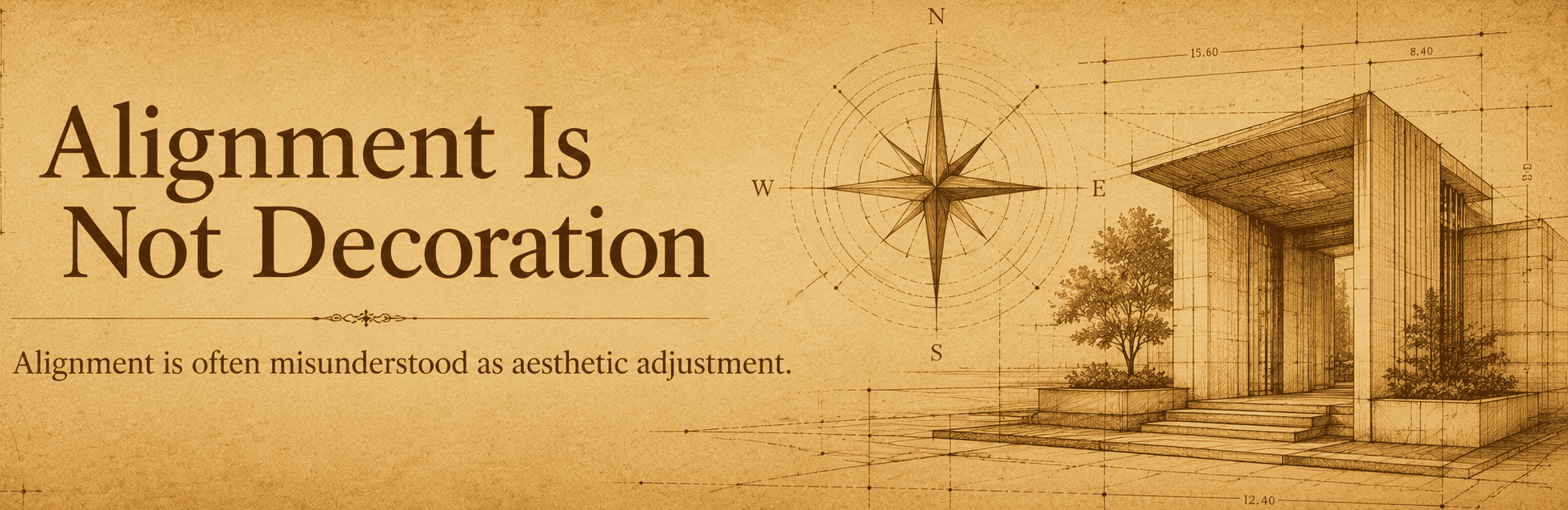
In many contemporary spaces, alignment is interpreted as
symmetry, ornament, or visual harmony. While aesthetic
coherence carries value, structural alignment operates at a
deeper level. It concerns directional logic, proportional
integrity, elemental distribution, and functional congruence.
A beautifully designed interior may still hold structural
dissonance. An impressive façade may conceal directional
imbalance. Visual appeal alone does not guarantee
environmental coherence.
Alignment begins with orientation.
Cardinal directions are not symbolic abstractions. They
represent environmental forces that influence light
exposure, thermal variation, airflow patterns, and
psychological perception. The placement of primary
functions in relation to these directions shapes the
behavioral field of a structure.
Consider a residential environment in which the zone of
nourishment is displaced from its optimal quadrant. The
aesthetic may remain intact. Appliances may gleam. Yet
over time, the rhythm of sustenance may feel unsettled.
Meals may lack cohesion. Energy may disperse rather than
consolidate.
In enterprise environments, the misalignment of authority
zones produces subtler but measurable shifts. Leadership
may find itself expending disproportionate effort to
maintain clarity. Strategic intent may require repeated
reinforcement. Decision processes may elongate.
Alignment restores congruence between function and
orientation.
It is neither ornamental nor performative. It is
structural.
The Vāstu Purusha Mandala, often depicted symbolically,
functions as a proportional matrix. It maps zones of
activity according to elemental and directional logic.
When applied with discipline, it serves as a diagnostic
grid through which existing spaces can be read.
Alignment involves asking precise questions:
Where is weight concentrated?
Where does light enter?
How does movement unfold?
Which quadrant carries authority?
Which zone anchors nourishment?
How does entry transition into interior experience?
Decoration engages surface.
Alignment engages structure.
In institutional settings, alignment influences
reputation. Visitors intuitively register coherence.
They sense clarity in reception geometry, in axis lines
that guide movement, and in spaces that hold purpose
without confusion.
Alignment communicates order.
True alignment requires restraint. It demands
proportionate intervention rather than excessive layering.
When calibration is precise, space begins to breathe
differently. Movement finds natural direction. Attention
consolidates. Occupants report steadiness.
Alignment is therefore an architectural conversation
between intention and structure.
It honors the intelligence embedded in direction and
geometry. It respects the interdependence of elements.
It recognizes that built environments shape human
patterns in ways that often precede conscious awareness.
When alignment is restored, decoration becomes secondary.
Structure carries the field.